No products in the cart.
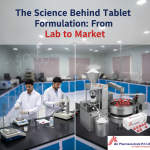
Every time you take a tablet, you're experiencing the result of years of pharmaceutical research, precise formulation science, and rigorous quality control. At Air Pharmaceuticals, the journey from initial concept to the tablet in your hand is a fascinating blend of chemistry, engineering, and medical science. Let's explore the intricate process of tablet formulation and manufacturing.
What is Tablet Formulation?
Tablet formulation is the pharmaceutical science of designing and developing solid dosage forms that deliver the right amount of active ingredient to the body in the most effective way possible. It's far more complex than simply compressing powder into a tablet shape—it requires careful consideration of chemistry, physics, biology, and manufacturing engineering.
A pharmaceutical tablet is a precisely engineered delivery system designed to:
- Deliver the exact dose of active pharmaceutical ingredient (API)
- Protect the API from degradation
- Release the medication at the right time and place in the body
- Remain stable throughout its shelf life
- Be easy to swallow and handle
- Taste acceptable (or be tasteless)
The Anatomy of a Tablet
While a tablet may look simple, it's actually a sophisticated formulation containing multiple carefully selected ingredients, each serving a specific purpose.
💊 Active Pharmaceutical Ingredient (API)
The therapeutic compound that provides the medicinal effect—the "drug" itself. This is typically present in small amounts (milligrams) but is the most critical component.
📦 Excipients (Inactive Ingredients)
These "helper" ingredients make up the bulk of the tablet and serve various essential functions:
- Binders: Hold the tablet together (e.g., cellulose, starch)
- Fillers/Diluents: Add bulk to achieve the desired tablet size (e.g., lactose, microcrystalline cellulose)
- Disintegrants: Help the tablet break apart in the stomach (e.g., croscarmellose sodium)
- Lubricants: Prevent sticking to manufacturing equipment (e.g., magnesium stearate)
- Glidants: Improve powder flow during manufacturing (e.g., colloidal silicon dioxide)
- Coating agents: Protect the tablet, improve appearance, or control release
Stage 1: Research and Development (R&D)
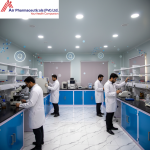
The journey begins in our research and development laboratory, where pharmaceutical scientists work to create the optimal formulation.
Preformulation Studies
Before formulation begins, our scientists conduct extensive preformulation studies to understand the physical and chemical properties of the API:
- Solubility Analysis: How well does the API dissolve in various media?
- Stability Testing: How does the API react to light, heat, moisture, and pH?
- Particle Size Analysis: What is the optimal particle size for absorption?
- Polymorphism Studies: Does the API exist in different crystal forms?
- Compatibility Testing: How does the API interact with potential excipients?
Formulation Development
Based on preformulation data, our scientists design the tablet formulation:
- Excipient Selection: Choosing the right combination of inactive ingredients
- Ratio Optimization: Determining the precise amounts of each ingredient
- Manufacturing Method Selection: Deciding between wet granulation, dry granulation, or direct compression
- Prototype Development: Creating small batches for testing
- Iterative Testing: Refining the formulation based on test results
Stage 2: Formulation Optimization
Once a promising formulation is identified, it undergoes rigorous optimization to ensure it meets all quality parameters.
Critical Quality Attributes (CQAs)
Our formulation scientists optimize the tablet to achieve specific quality targets:
⚖️ Weight Uniformity
Each tablet must weigh the same to ensure consistent dosing
💪 Hardness
Tablets must be strong enough to withstand handling but not too hard to dissolve
⏱️ Disintegration Time
Tablets must break apart within specified time limits
🌊 Dissolution Rate
The API must release at the correct rate for optimal absorption
🎯 Content Uniformity
Each tablet must contain the exact amount of API
📅 Stability
The tablet must maintain quality throughout its shelf life
Stage 3: Scale-Up and Process Development
Once the formulation is optimized in the lab, it must be scaled up for commercial manufacturing. This is a critical phase where laboratory processes are translated to industrial-scale production.
Pilot Batch Production
Before full-scale manufacturing, we produce pilot batches to:
- Validate that the formulation works at larger scales
- Identify and resolve potential manufacturing challenges
- Optimize processing parameters (mixing time, compression force, etc.)
- Establish standard operating procedures (SOPs)
- Train production staff
Stage 4: Manufacturing Process
At Air Pharma's state-of-the-art manufacturing facility, tablets are produced through carefully controlled processes. The most common methods include:
Method 1: Wet Granulation
This is the most widely used method for tablet manufacturing:
- Mixing: API and excipients are blended together
- Granulation: A liquid binder is added to form granules
- Drying: Granules are dried to remove moisture
- Sizing: Dried granules are passed through screens for uniform size
- Blending: Final excipients (lubricants, glidants) are added
- Compression: The blend is compressed into tablets
Method 2: Dry Granulation
Used for moisture-sensitive or heat-sensitive APIs:
- Mixing: API and excipients are dry-blended
- Compaction: The blend is compacted into large tablets or ribbons
- Milling: Compacted material is milled into granules
- Final Blending: Lubricants are added
- Compression: Final tablets are formed
Method 3: Direct Compression
The simplest method, suitable for certain formulations:
- Mixing: All ingredients are blended together
- Compression: The blend is directly compressed into tablets
Stage 5: Tablet Compression
Tablet compression is where the formulation literally takes shape. Our high-speed rotary tablet presses can produce thousands of tablets per hour with incredible precision.
The Compression Process
Modern tablet presses use a sophisticated process:
- Die Filling: Powder blend flows into the die cavity
- Pre-Compression: Initial light compression removes air
- Main Compression: High pressure forms the final tablet
- Ejection: The finished tablet is ejected from the die
Critical parameters monitored during compression include:
- Compression force
- Tablet weight
- Tablet thickness
- Hardness
- Production speed
Stage 6: Coating (When Required)
Many tablets receive a coating for various reasons. At Air Pharma, we use advanced coating technology to apply thin, uniform coatings.
Types of Coatings
🎨 Film Coating
Thin polymer coating that improves appearance, protects from moisture, masks taste, and makes tablets easier to swallow
🛡️ Enteric Coating
Special coating that resists stomach acid, allowing the tablet to dissolve in the intestines instead
⏰ Controlled-Release Coating
Specialized coating that controls the rate of drug release over time
Stage 7: Quality Control Testing
Before any batch reaches the market, it undergoes comprehensive quality control testing in our advanced analytical laboratory.
In-Process Quality Control
During manufacturing, we continuously monitor:
- Tablet weight variation
- Hardness and friability
- Thickness and diameter
- Disintegration time
Finished Product Testing
Completed batches undergo extensive testing:
- Assay: Precise measurement of API content using HPLC or UV spectroscopy
- Dissolution Testing: Verifying the tablet releases API at the correct rate
- Content Uniformity: Ensuring consistent API distribution across tablets
- Microbial Testing: Confirming absence of harmful microorganisms
- Stability Testing: Verifying the product maintains quality over time
Stage 8: Packaging
Proper packaging is crucial for maintaining tablet quality from manufacturing to consumption.
Packaging Considerations
- Moisture Protection: Blister packs or bottles with desiccants
- Light Protection: Opaque or amber-colored materials for light-sensitive drugs
- Child Safety: Child-resistant closures when required
- Tamper Evidence: Seals that show if the package has been opened
- Information: Clear labeling with dosage, expiry, and usage instructions
Stage 9: Stability Studies
Even after a product reaches the market, we continue monitoring its quality through ongoing stability studies.
Stability Testing Program
- Long-Term Studies: Storing samples under normal conditions and testing at regular intervals
- Accelerated Studies: Testing under stressed conditions to predict shelf life
- Photostability Testing: Evaluating the effect of light exposure
- In-Use Stability: Testing how the product holds up after opening
Stage 10: Regulatory Approval and Market Launch
Before a tablet can be sold, it must receive approval from regulatory authorities.
Regulatory Requirements
- Complete formulation disclosure
- Manufacturing process documentation
- Quality control data
- Stability study results
- Bioequivalence studies (for generic drugs)
- Clinical trial data (for new drugs)
At Air Pharma, all our products are registered with and approved by the Drug Regulatory Authority of Pakistan (DRAP), ensuring they meet national pharmaceutical standards.
Innovation in Tablet Formulation
Pharmaceutical science is constantly evolving. At Air Pharma, we invest in innovative formulation technologies:
🔬 Nanotechnology
Using nanoparticles to improve drug solubility and bioavailability
⏱️ Advanced Release Systems
Developing sophisticated controlled-release and targeted-delivery formulations
🌿 Natural Excipients
Exploring plant-based and biodegradable excipients
💊 Orally Disintegrating Tablets
Creating tablets that dissolve rapidly in the mouth without water
🎯 Personalized Medicine
Developing flexible formulations for customized dosing
♻️ Sustainable Manufacturing
Implementing eco-friendly processes and reducing waste
Challenges in Tablet Formulation
Creating the perfect tablet formulation involves overcoming numerous challenges:
- Poor Solubility: Many APIs have low water solubility, requiring special formulation techniques
- Stability Issues: Some drugs degrade easily, requiring protective formulations
- Taste Masking: Making bitter drugs palatable without affecting efficacy
- Bioavailability: Ensuring the drug is absorbed effectively by the body
- Manufacturing Challenges: Scaling up from lab to production while maintaining quality
- Cost Optimization: Balancing quality with affordability
Air Pharma's Commitment to Excellence
At Air Pharmaceuticals, tablet formulation is both a science and an art. Our commitment to excellence is reflected in:
👨🔬 Expert Team
Highly qualified pharmaceutical scientists and formulation experts
🏭 Modern Facilities
State-of-the-art manufacturing and testing equipment
📊 Quality Systems
Rigorous quality control at every stage of production
🔬 R&D Investment
Continuous investment in research and innovation
✅ Regulatory Compliance
Full adherence to GMP and regulatory standards
🌍 Patient Focus
Every decision guided by patient safety and efficacy
From Science to Your Health
The next time you take a tablet from Air Pharma, remember the incredible journey it has taken—from initial research and formulation development, through precision manufacturing and rigorous quality testing, to the final product in your hand. Each tablet represents the culmination of pharmaceutical science, engineering excellence, and our unwavering commitment to your health.
This complex process, refined over decades of pharmaceutical innovation, ensures that every tablet delivers exactly what it promises: safe, effective, and reliable medication you can trust.
Air Pharmaceuticals (Pvt) Ltd. - Your Health Companion
Where Science Meets Care
Learn More About Our Manufacturing Excellence
Interested in learning more about our pharmaceutical manufacturing processes and quality standards?